
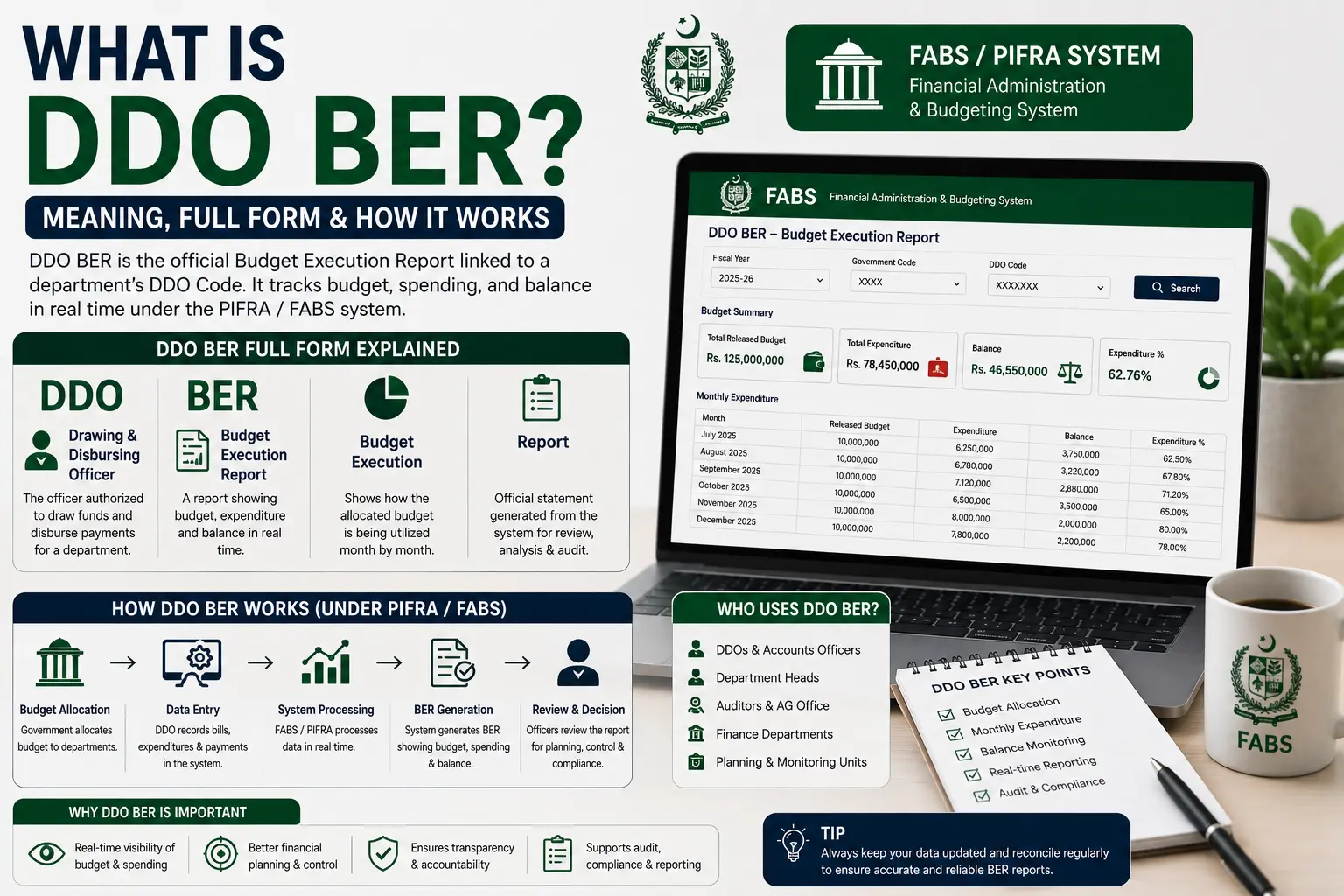
What is DDO BER? In short, it’s the official Budget Execution Report tied to a government department’s Drawing and Disbursing Officer code — the single most-referenced financial document for tracking budget, spending, and balance at the department level in Pakistan.
This guide breaks down the full form, what each part of the term means, how the system works under PIFRA/FABS, and who actually uses it day-to-day.
DDO BER Full Form Explained
DDO BER stands for Drawing and Disbursing Officer Budget Execution Report. It’s the report generated for a specific department’s Drawing and Disbursing Officer, showing how that department’s approved budget is being released and spent throughout the fiscal year.
What is DDO BER?
In plain terms: DDO BER is a live financial snapshot — not a static annual document, but a report that updates as transactions are processed — showing a department exactly how much of its budget has been authorized, how much has been spent, and how much remains available.
What Does DDO Stand For?
DDO stands for Drawing and Disbursing Officer — a government official formally authorized to draw funds from the government treasury and disburse payments on behalf of their department.
Every government office that spends public money, from a district hospital to a federal ministry, operates under one or more DDOs, each identified by a unique DDO Code assigned when the position is sanctioned.
The DDO is personally accountable for how the funds under their code are spent, which is part of why regularly checking the department’s DDO BER matters — it’s a direct reflection of that officer’s financial responsibility.
What Does BER Stand For?
BER stands for Budget Execution Report — the document (or, in this case, the live online report) that tracks how a budget allocation is executed over the course of the fiscal year. A Budget Execution Report typically shows:
- The original budget allocated at the start of the year.
- The released budget — the portion actually authorized for spending so far.
- Expenditure figures, broken down by month and by budget head.
- The remaining balance available against both the original and any revised (final) budget.
Why “Execution” Specifically
The word “execution” matters here — it distinguishes this report from a budget plan (what was originally allocated) and focuses instead on what’s actually happening as the year progresses: how much has genuinely been spent, released, and remains, rather than just what was approved on paper months earlier.
How the DDO BER System Works Under PIFRA
DDO BER reports are generated through the Financial Accounting and Budgeting System (FABS) — the system that succeeded the original PIFRA project (Project to Improve Financial Reporting and Auditing).
PIFRA was a reform initiative that officially closed in December 2014, with its live operational system, FABS, mainstreamed into the Office of the Controller General of Accounts (CGA), Pakistan.
In practical terms, the system works like this: every financial transaction a department processes — a bill payment, a salary disbursement, a budget release — gets recorded through the underlying government accounting infrastructure.
That data then feeds into the public-facing FABS portal, where a DDO can search their department’s DDO BER using their Government Code and DDO Code to see an up-to-date picture of their budget position, without needing to request a manual report from a higher accounts office.
Who Uses DDO BER? (Government Departments & Employees)
DDO BER isn’t a single-purpose tool — different people within the government system use it for different reasons:
Drawing and Disbursing Officers use it as their primary tool for monitoring their department’s real-time budget position and ensuring spending stays within released limits.
Accounts staff use it to reconcile departmental records against the official system figures, catching discrepancies before they become audit issues.
Auditors reference DDO BER data when reviewing a department’s financial year, since it provides a documented, system-generated trail of budget releases and expenditure.
Individual employees interact with related modules under the same system — checking salary slips, bill status, or their own service records — even if they aren’t directly responsible for the department’s overall budget.
Government-Wide Reach
Because every DDO Code is tied to a specific department under Federal, Punjab, Sindh, KPK, Balochistan, or one of the other government tiers, DDO BER touches essentially every public-sector office in the country in some form, from a small district office to a large federal ministry.
DDO BER vs Other PIFRA Reports (brief comparison)
DDO BER is one of several report types available through the FABS/PIFRA system, and it’s worth understanding how it differs from a couple of commonly confused alternatives:
- DDO BER vs. Salary Slip reports — DDO BER covers overall department budget and expenditure; a salary slip is an individual employee’s pay breakdown for a specific month, a much narrower scope.
- DDO BER vs. Position Code / Open-Filled Post reports — DDO BER is a financial report; the position code report is an HR/staffing report showing sanctioned, filled, and vacant posts. They’re related (vacant posts affect salary expenditure), but track different things entirely.
- DDO BER vs. Bill Status reports — a bill status check tracks one specific transaction through processing and payment; DDO BER gives you the aggregate financial picture that the bill eventually feeds into.
In short, DDO BER is the department-wide financial summary, while the other reports zoom into specific slices — an individual’s pay, a single post, or one transaction.
FAQs
What is DDO BER in simple terms?
It’s the Budget Execution Report showing how much of a government department’s budget has been released, spent, and remains available, tied to that department’s Drawing and Disbursing Officer code.
What does DDO stand for?
Drawing and Disbursing Officer — the official authorized to draw and disburse government funds for a department.
What does BER stand for?
Budget Execution Report — the live report tracking how a budget allocation is actually being spent over the fiscal year.
Is DDO BER the same as PIFRA?
DDO BER is a report generated through the system — PIFRA was the original project, now succeeded by FABS under the Controller General of Accounts.
Who is responsible for checking a department’s DDO BER?
Primarily, the Drawing and Disbursing Officer and their accounts staff, though auditors and higher accounts offices also reference it.
How is DDO BER different from a salary slip?
DDO BER covers the whole department’s budget and expenditure; a salary slip is one employee’s individual pay breakdown.
Conclusion
What is DDO BER? At its core, it’s a straightforward concept wrapped in government terminology — a live budget execution report tied to a Drawing and Disbursing Officer’s department code, showing exactly how much of the budget has been released, spent, and remains for the rest of the fiscal year.
Understanding the DDO and BER parts of the name separately makes the whole system far less confusing, and knowing how it differs from related reports like salary slips, position codes, and bill status checks helps you find the right report the first time instead of searching through the wrong module.